

National provider identification: one ID for every payer
National provider identification is the NPI (National Provider Identifier), a 10-digit number that names a health care provider in HIPAA standard transactions. CMS assigns it through NPPES. Nine digits carry the identity and the tenth is a check digit.
CMS lists no fee to get one or to look one up. This page sorts the NPI from the other numbers providers carry: PTAN, CCN, Medicaid IDs, DEA numbers, licenses, tax IDs and more. For the basics of the NPI itself, see What Is an NPI Number?.
National provider identification meaning, word by word
National provider identification means a standard, nationwide number that identifies a health care provider. Take each word in turn.
- National: one standard for every health plan, so you stop juggling a different number per payer.
- Provider: a health care provider as defined in 45 CFR 160.103. That covers individuals and organizations.
- Identification: a unique number. It has no meaning built in.
Many people search "what is national provider identification" or "what is a national provider id." The answer is the same: the NPI.
National provider id: what the number carries and what it does not
A national provider id carries no information about you. Under 45 CFR 162.406 the NPI has no embedded intelligence. It does not reveal your state or your specialty.
It also proves less than people assume. Having an NPI does not show that a provider is licensed or credentialed. It does not guarantee payment. It does not enroll anyone in a health plan. CMS says an NPI is required for Medicare enrollment but does not replace it.
NPI national provider identification and the rule behind it
The NPI exists because of HIPAA and its Administrative Simplification rules, codified in 45 CFR Part 162, Subpart D. CMS published the NPI Final Rule on January 23, 2004. It took effect May 23, 2005, and providers could apply from that date.
Covered providers, and health plans other than small ones, had to comply by May 23, 2007. Small health plans had until May 23, 2008. The same rule lets you use the NPI for any other lawful purpose.
National provider number, provider number and provider id: why the names blur
"National provider number" and "nation provider id" are common ways to say NPI. Context decides the rest.
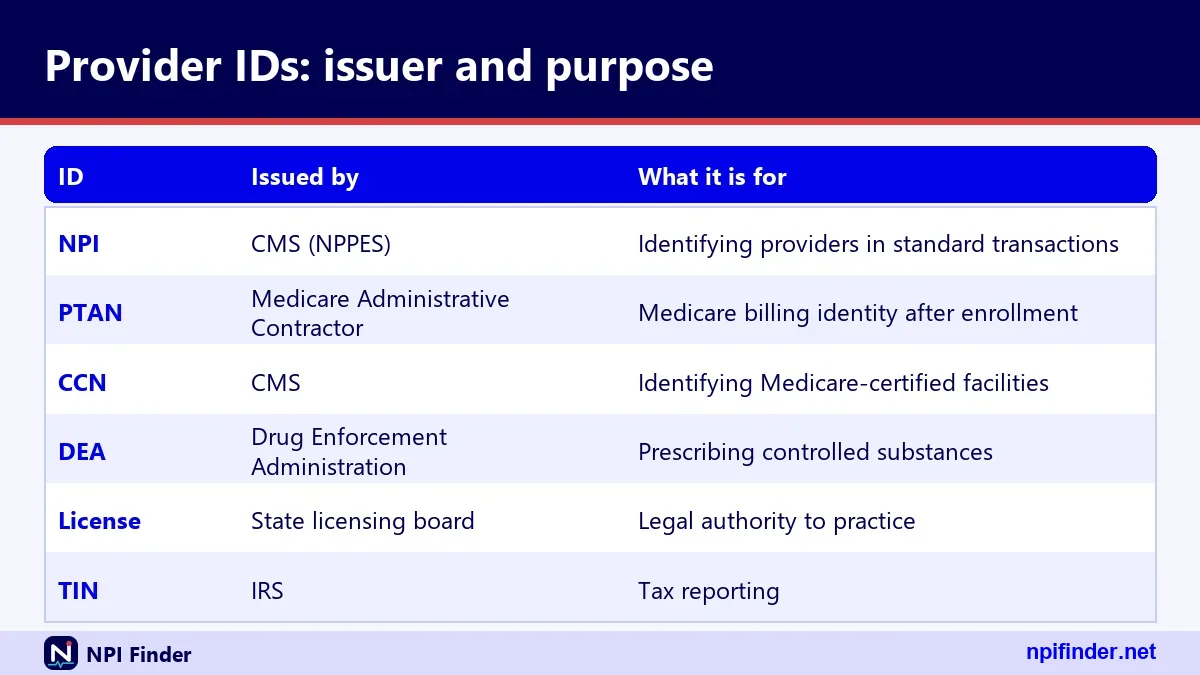
"Provider number" or "provider id number" on a Medicare form often points to the PTAN, which CMS also calls the Medicare provider number. On a Medicaid form it usually means a state-issued ID. In a credentialing packet it can mean a plan-specific number. If a form just says "provider ID," ask which agency or plan issues it before you type anything.
Provider ID comparison: what each identifier is for and where to look it up
The table below is the fast answer to "which number is this?" Every row is a different identifier with a different issuer.
| Identifier | Issued by | What it is for | Where to look it up |
|---|---|---|---|
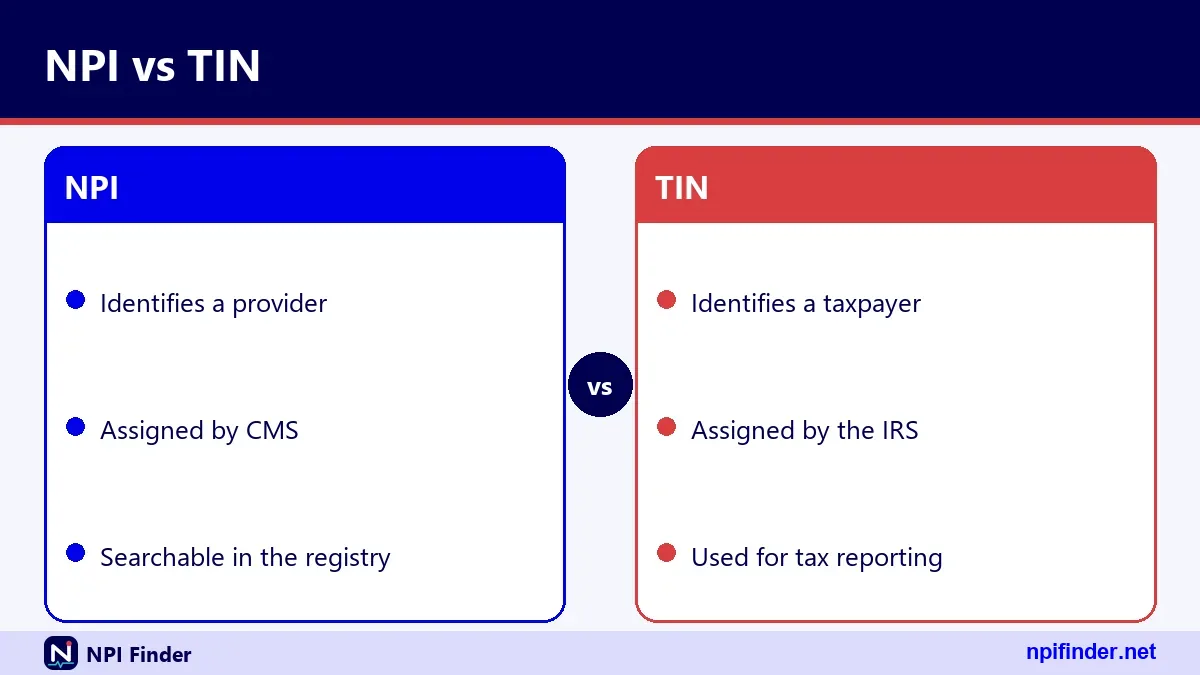
| NPI | CMS, through NPPES | Names a provider in standard HIPAA transactions | NPI Registry (public, free) |
| PTAN | Your Medicare Administrative Contractor (MAC) | Billing Medicare, also called the Medicare identification number | Your MAC; no public lookup verified |
| CCN | CMS | Identifies Part A facilities such as hospitals and nursing facilities | Provider of Services data from CMS |
| Medicaid provider ID | Each state Medicaid agency | Billing and enrolling with that state program | The state Medicaid agency |
| DEA number | DEA Diversion Control Division | Controlled substance registration | DEA registration validation (login) |
| State license | State licensing board | Legal permission to practice | The state board; echoed in NPPES taxonomy data |
| TIN or EIN | IRS | Tax reporting for businesses and organizations | Your own IRS paperwork |
| UPIN | CMS (retired) | Old Medicare physician identifier | Historical UPIN directory only |
| CLIA number | CLIA Data System | Identifies a laboratory | CMS CLIA lab lookup |
| CAQH ID | CAQH | Credentialing data sharing | CAQH or the requesting organization |
| NCPDP or NABP ID | NCPDP, NABP | Pharmacy identification | The pharmacy or the issuing organization |
So, NPI is the best identifier for naming a provider on claims because it is the standard HIPAA identifier that CMS issues through NPPES.
Find national provider identification number: the fastest routes
The fastest way to find a national provider identification number is the NPI Registry, CMS's public search. It needs no login and costs nothing. Three routes cover almost every case, and the steps below walk the first one.
Search the NPI Registry by name and state
Enter the provider's last name, first name and state. State alone is not accepted as a search; the Registry asks for another criterion. Add a city or postal code if the name is common. The web search shows only the first 2,100 results, so narrow early. You can also browse by NPI Lookup by State or NPI Lookup by Specialty.
Log in to NPPES if the number is your own
If you are the provider, your NPI is stored in your NPPES account. Sign in with your I&A (Identity and Access) User ID. NPPES Login Help covers sign-in trouble, and Find My NPI Number covers every recovery route.
Four steps to a verified NPI
- Search the NPI Registry with the provider's last name, first name and state.
- Open the record and confirm the practice address and specialty match the person you mean.
- Check the status. "A" means active.
- Copy the 10-digit number and run it through the NPI Number Validator if you will type it into a claim.
Tip: Match on practice address, not mailing address. Mailing addresses are often an office box or a home address, so they mislead.
Ask the provider or the billing office
Covered providers must disclose their NPI to any entity that needs it. A direct request is legitimate and often quicker than a name search on a common surname.
National provider identification number search in the NPI Registry
A national provider identification number search in the Registry works by number, by name or by organization. Use the narrowest key you have, because the Registry matches exactly unless you use a wildcard.
Search by the NPI itself
Type exactly 10 digits. Fewer or more digits return an error saying the NPI must be 10 digits. A well-formed number that is not assigned returns zero results.
Search by name with a trailing wildcard
Add an asterisk after at least two leading characters, such as "smi*". A single-letter prefix with a wildcard is rejected. Without an asterisk, "sm" is an exact match and returns nothing useful.
Narrow by city, postal code or taxonomy
Combine a name with a city, state or ZIP code. A five-digit ZIP also matches ZIP+4 records. To search by specialty, use the exact taxonomy description or a wildcard after two characters.
Lookup national provider number through the NPI Registry API
You can lookup national provider number records in JSON through the free NPI Registry API. It returns the same data as the web search. Developers should read the rules below before building anything.
The version parameter is mandatory
Every call must pass version 2.1. A missing version, or version 2.0 or 3.0, returns error 17, "Unsupported Version". The API replies with HTTP 200 even for errors, so read the response body.
Limit and skip
The documented defaults are limit 10 and a maximum of 200 per call, with skip up to 1,000. In our tests a limit above 200 was silently capped at 200. Do not build anything that depends on behavior beyond the documented values.
Error responses
Errors arrive as a list with a description, a field and a number. Examples: 03 for wildcard rules, 04 for no valid search criteria, 06 for a bad NPI length, and 07 for a state-only search.
Lookup national provider identification number with the NLM Clinical Tables tool
To lookup national provider identification number records from a web page, use the NLM Clinical Tables NPI search. It sends the CORS header that browsers need, which the CMS Registry API does not.
Individuals and organizations use separate searches
One search covers individual providers and another covers organizations. Both take a required terms value. Multiple terms are combined, and partial words match.
Display fields and paging
The default display row shows the name, the NPI, the provider type and the practice address. The tool returns up to 7 rows by default and up to 500 per page. Total counts cap at 10,000.
A quirk worth knowing
When we asked for the taxonomy code as an extra field on the sample record, the response held a null. Test every field path on a known NPI before you rely on it.
National provider id search results: reading every field
A national provider id search returns one JSON record per NPI. The same record powers the full output on this site, so the field names below match what you see in the raw response.
The basic block
The basic block holds the name, credential, sex, sole proprietor flag, enumeration date, last updated date and status. Status "A" means active. Enumeration date is when the NPI was first assigned.
Addresses and practice locations
The addresses list holds one LOCATION and one MAILING address. The practiceLocations list holds secondary practice sites. Our sample record shows a mailing address in Maryland and secondary locations in Virginia, Maryland and Washington, DC.
Taxonomies, identifiers, other names and endpoints
Taxonomies pair a code and description with a license number and state. The identifiers list holds other IDs a provider chose to enter. The sample record leaves identifiers, other_names and endpoints empty. That is normal.
National provider number search for organizations and subparts
A national provider number search for a hospital or group returns an NPI-2 record. These work like individual records but carry different fields.
Organization records
The basic block holds the organization name and the authorized official's name, title and phone. Organizations can hold more than one NPI. Individuals are eligible for only one.
Subparts
A hospital unit can have its own NPI if its identifying data are unique. The record flags this with organizational_subpart set to YES or NO. The subpart concept does not apply to individuals.
Doing business as names
Organization records can list a doing-business-as name in other_names. Search both the legal name and the DBA when a clinic seems missing.
National provider id number lookup and the check digit
Every NPI ends in a check digit that you can verify yourself with the Luhn formula. A passing check proves the number is well formed. It does not prove the number is assigned. The NPI Number Validator automates this.
The Luhn rule with the 80840 prefix
CMS calculates the check digit as if the prefix 80840 sits in front of the nine digits. In practice you can skip the prefix and add the constant 24 in the second step. The prefix matters only on health ID cards.
Worked example
CMS publishes 123456789 as its example. The check digit is 3, so 1234567893 is well formed. It is not a registered NPI. The live Registry returns zero results for it, so treat it as a format example.
Check it in five steps
- Take the first nine digits of the NPI.
- Double every other digit, starting with the rightmost of the nine.
- Add the digits of those products to the digits you did not double, then add 24.
- Subtract that total from the next number ending in zero.
- Compare the result with the tenth digit of the NPI.
Warning: A check-digit pass is not a lookup. A real number with one wrong digit fails and returns no record, so confirm any NPI in the Registry too.
Provider id lookup limits: hourly caps, result caps and bulk files
Provider id lookup in the Registry is capped on purpose. CMS limits the number of queries per hour, and bulk use belongs in the downloadable file.
Hourly query limits
Effective June 25, 2024, NPPES limited the number of NPI Registry queries allowed per hour. The numeric limit is not published, so build retry and back-off logic and avoid loops.
Result caps
The web search returns at most the first 2,100 results. The API documents a limit of 200 per call and a skip of up to 1,000. Narrow the search instead of paging deep.
When to switch to files
CMS says bulk Registry queries must use the dissemination file. If you need thousands of records, go to NPI Database & Download.
National provider number directory: the downloadable NPPES files
The closest thing to a national provider number directory is the NPPES Data Dissemination file set from CMS. It is free to download. CMS offers no help desk for using it.
Full, weekly and deactivation files
CMS publishes a monthly full replacement file, a weekly incremental update and a monthly deactivation file. The registry itself is a query-only database updated daily. The current listing is the November 9, 2026 version.
File size and tooling
The zip is about 1.08 GB, and the data file exceeds 4 GB uncompressed. Older extraction tools may fail. Plan for disk space and a modern unzip utility.
Version 2 only
Version 1 of the monthly and weekly files has not been supported since March 3, 2026. Use version 2. Deactivated NPIs show only the NPI and the deactivation date.
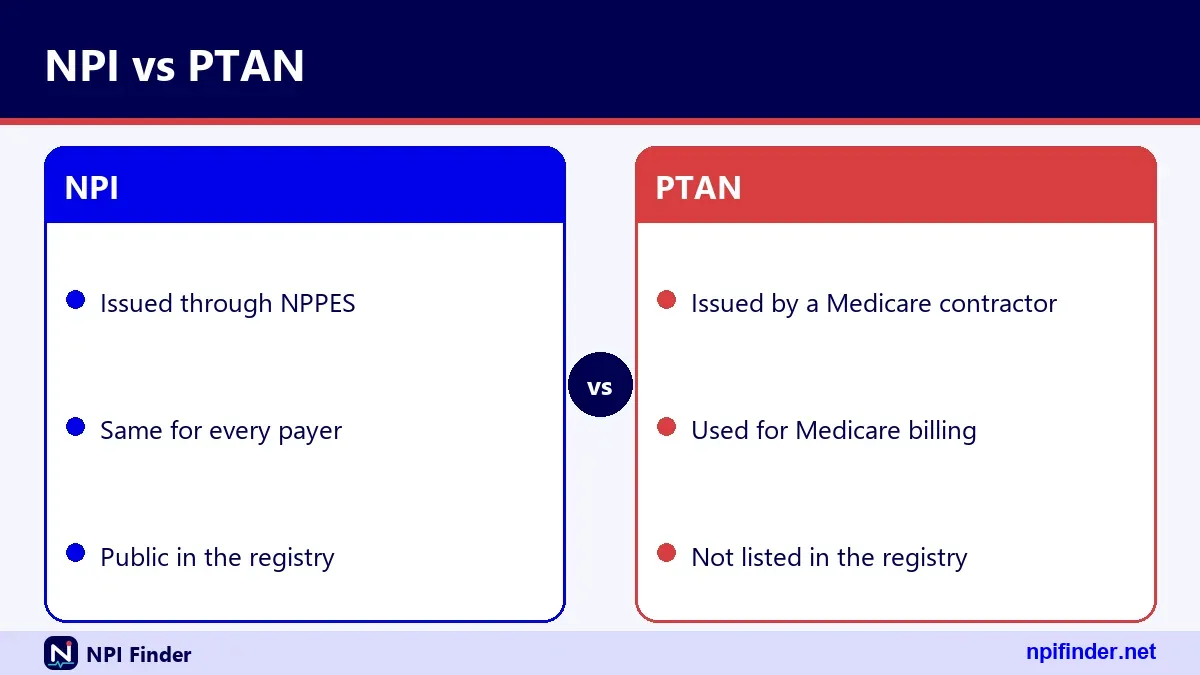
PTAN number: the Medicare billing ID that is not your NPI
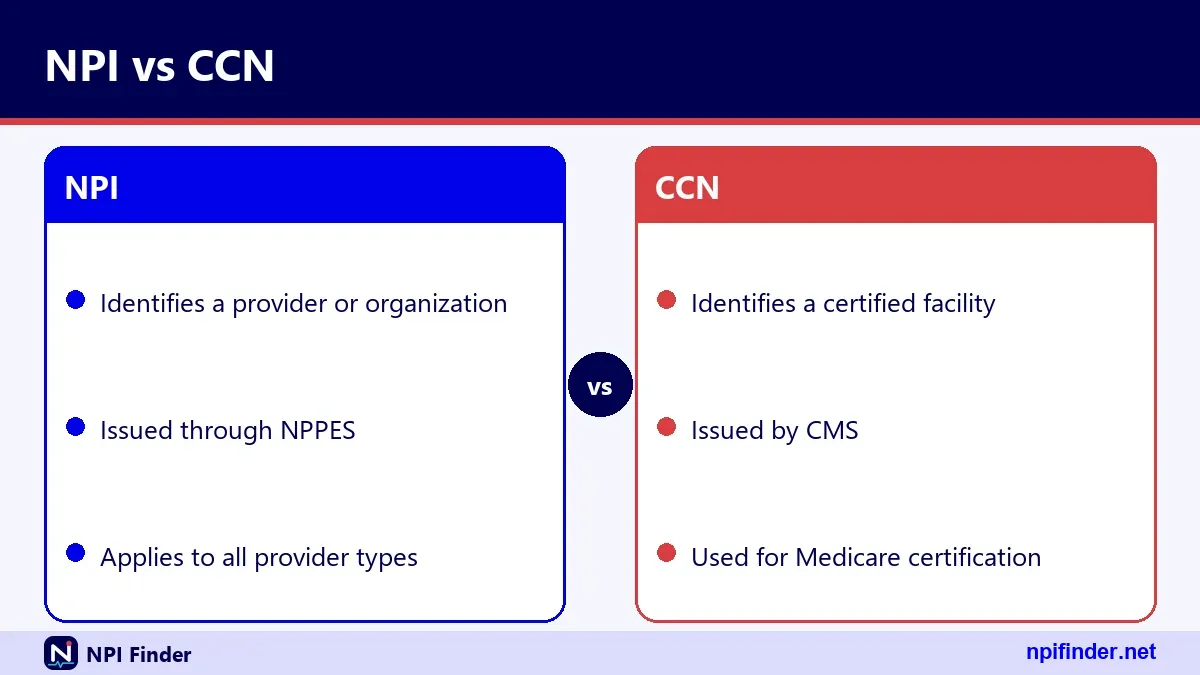
A PTAN number is the Provider Transaction Access Number, the identifier your Medicare Administrative Contractor (MAC) issues when you enroll in Medicare. It is separate from your NPI. You need both.

What is a PTAN for Medicare
CMS forms call it the Medicare identification number. It is also known as the Medicare provider number, Medicare billing number or legacy number. For Part B suppliers, the Medicare identification number is the PTAN.
Medicare PTAN versus NPI
The NPI is permanent and public. The PTAN is tied to your Medicare enrollment and is issued by your MAC. Claims use the NPI as the standard identifier. Medicare still keeps the PTAN on your enrollment record.
Why people search "ptan medicare" and "ptan search"
Most people searching these terms want one thing: the number on a Medicare enrollment record. The NPI Registry does not hold it. Your MAC does.
PTAN lookup: how to find your PTAN number
PTAN lookup starts with your own enrollment records, because we found no public CMS tool that returns a PTAN from an NPI. Your MAC is the authority.
PTAN lookup by NPI
Searching "ptan lookup by npi" will surface many third-party pages. None of them are CMS. The NPI Registry returns no PTAN. Be skeptical of any site that claims to look one up for you.
Where your PTAN lives
Your MAC assigned the number at enrollment, so correspondence from the MAC is the first place to check. PECOS Lookup & Revalidation explains what enrollment data you can see yourself, and PECOS Login covers access.
Recover a lost PTAN in four steps
- Search your enrollment and revalidation correspondence from your MAC.
- Sign in to PECOS with your I&A account and review your enrollment record.
- If the number is still missing, contact your MAC and be ready to verify your identity and NPI.
- Write the PTAN into your practice records, next to the NPI.
Warning: Never pay a website for a PTAN. Your MAC assigns it, and CMS lists no fee for lookups.
Medicare number lookup for providers
Medicare number lookup for a provider means finding an NPI, a PTAN or both. The word "number" alone is ambiguous, so first decide which one you need.
Medicare number for providers
For claims, use the NPI. For your Medicare enrollment record, use the PTAN. For facilities, use the CCN. Different tasks need different numbers.
Medicare ID number and Medicare numbers
This page covers provider identifiers. Patient Medicare cards and beneficiary numbers are a separate topic. The NPI Registry holds provider data only.
Medicare number lookup by name
To look up a doctor by name, search the NPI Registry for the NPI. To check who accepts Medicare, use Find a Medicare Provider.
Medicare provider number lookup with Care Compare and PECOS data
Medicare provider number lookup tools show enrollment and quality data, not billing numbers. Two CMS sources matter most.
Care Compare
Medicare Care Compare is the home of the former Physician Compare, now the Doctors and Clinicians section. Its general information comes mainly from PECOS. Clinicians can suppress their address through PECOS or the QPP Service Center.
The Order and Referring dataset
The Order and Referring dataset on data.cms.gov lists physicians and non-physician practitioners, by NPI, who are eligible to order and refer in Medicare. It is drawn from PECOS and published in dated snapshots. Check its data dictionary for current fields.
PECOS lookup and revalidation
Providers revalidate every five years, and DMEPOS suppliers every three years. CMS posts due dates seven months ahead. Late revalidation can lead to a payment hold and deactivation of billing privileges.
Medicaid provider number: state-issued IDs
A Medicaid provider number is assigned by an individual state Medicaid agency, so format and rules vary by state. No national lookup exists in our sources.
Medicaid provider ID and number lookup
For a Medicaid provider number lookup, contact the state Medicaid agency or its provider enrollment portal. The NPI Registry may list a Medicaid ID only if the provider entered one in the identifiers field.
Legacy Medicaid numbers versus the NPI
HIPAA standard transactions use the NPI. Legacy identifiers such as old Medicaid numbers are not permitted in those transactions once the NPI is in use.
What to bring when you ask
Have your NPI, your legal name or organization name, and your tax ID ready. The state agency will ask for them.
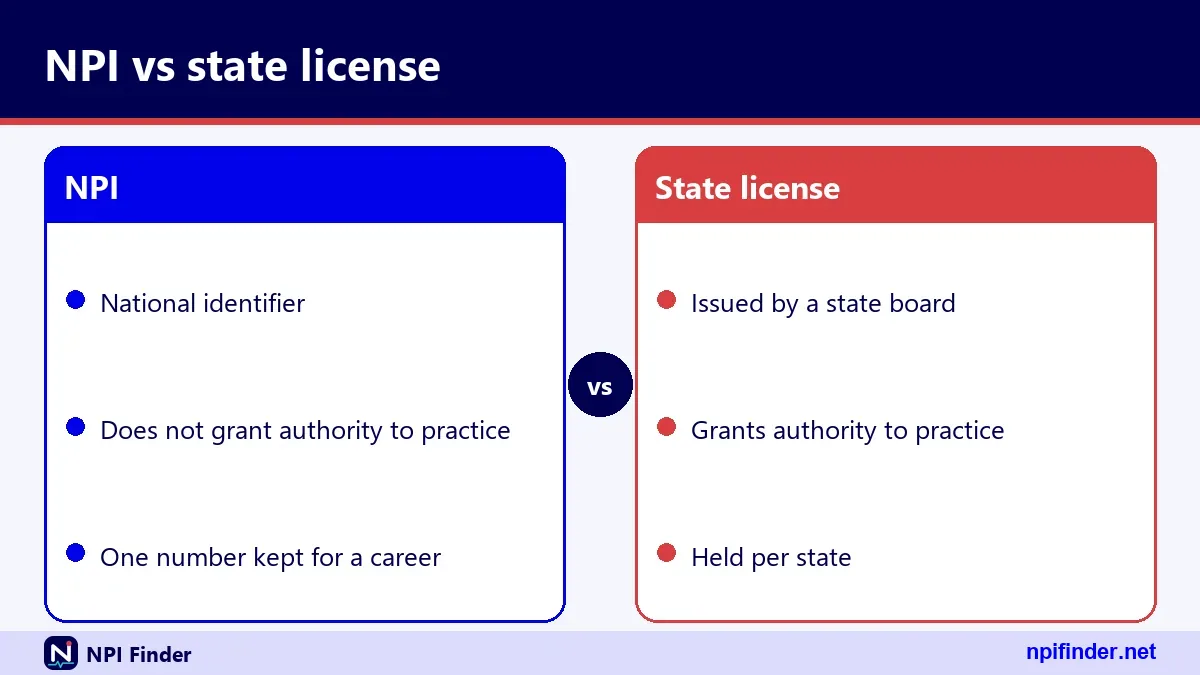
DEA lookup by NPI: what exists and what does not
A DEA lookup by NPI is not a single CMS or DEA service in our sources. The DEA number comes from the DEA Diversion Control Division, and the NPI comes from NPPES. They are separate systems.
DEA number format
A DEA number is two letters followed by seven digits. The first letter shows the registrant type, such as A, B, F or G for practitioners and hospitals. The second letter is usually the first letter of the registrant's last name.
DEA check digit
The DEA check digit is a format test, not a status check. It is published in a CMS document rather than by the DEA. Passing it does not prove the registration is active.
Check a DEA number in four steps
- Add digits 1, 3 and 5.
- Add digits 2, 4 and 6, then double that sum.
- Add the two results.
- The last digit of the total must equal digit 7.
Tip: BA1424326 passes, since 6 plus 2 times 10 is 26. AZ1234567 fails, since the total is 33.
Medical license number: where it lives and who confirms it
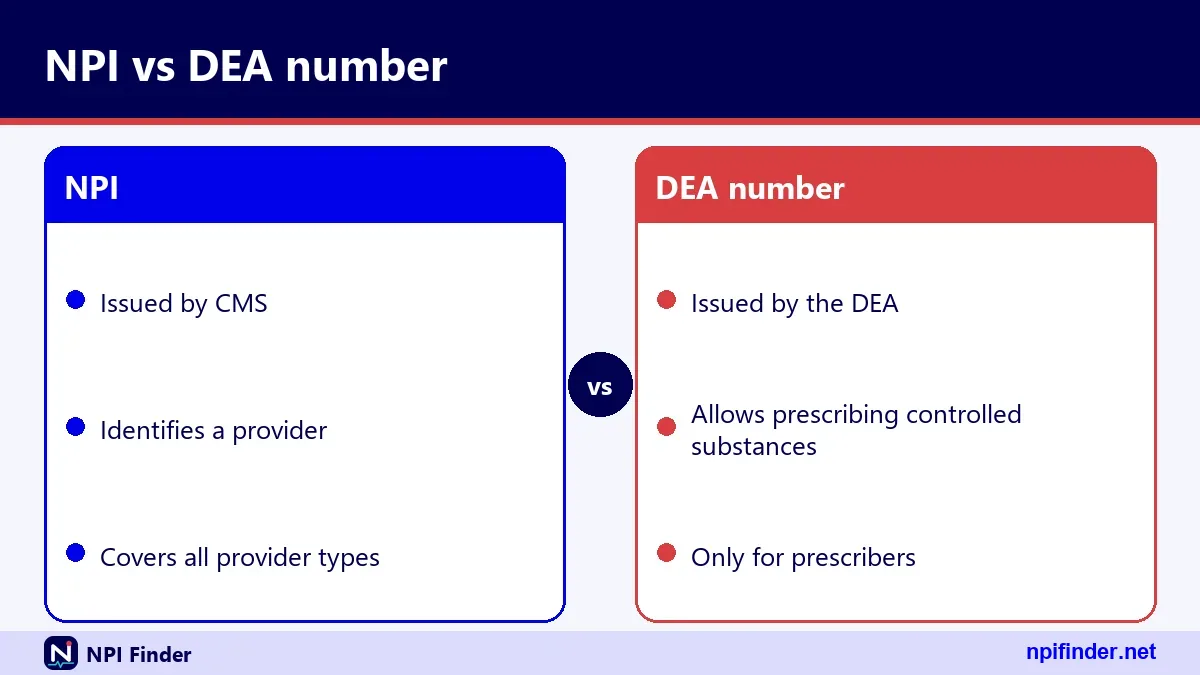
A medical license number comes from a state licensing board, not from CMS. The NPI does not verify licensure, so always confirm with the board.
Doctor license number and MD license number
NPPES taxonomy entries can carry a license number and the state that issued it. The sample record shows several. Treat them as self-reported. They are useful hints and not proof.
Physician license number lookup
To verify a physician license number, use the licensing board for the state on the record. A provider may hold licenses in more than one state, and the sample record lists licenses in Maryland, Virginia and Washington, DC.
NPI license lookup
Search "npi license lookup" and you will find sites that merely repeat the Registry. The authoritative answer is the board. Use NPI Lookup by State to find the right record first.
R N number lookup: where a nurse's number lives
An R N number lookup goes through the state, because registered nurse licenses are issued by state boards. The NPI Registry can hold a license number a nurse entered, but it cannot confirm that license is current.
The license number versus the NPI
A nurse's license number is a state credential. The NPI is a federal billing identifier. Many nurses who bill insurers hold both. Keep them labeled in your records.
Nurse practitioners and their taxonomy codes
Nurse practitioners use taxonomy codes such as 363L00000X for Nurse Practitioner and 363LF0000X for Family Nurse Practitioner. Look codes up with Taxonomy Code Lookup.
What the Registry will and will not tell you
The record shows the name, credential, taxonomy and any license entered. It does not show disciplinary history or renewal dates.
RN number lookup through NPPES license fields
An RN number lookup by NPI works only when the nurse listed a license in NPPES. Open the record and read the taxonomies block for a license and state.
RN number finder: reading the taxonomies block
Each taxonomy row has a code, a description, a license, a state and a primary flag. Only one row is flagged primary. Match the state to the board you plan to contact.
Search RN number by name
Search the Registry by last name, first name and state. Then confirm the license with the state board. Common names return many rows, so add a city.
When the license field is empty
Some records carry no license. Individuals in certain licensed professions must give license information when they apply, or explain why they have none. An empty field is not proof of an unlicensed nurse. Ask the nurse.
UPIN lookup: the retired Medicare physician ID
A UPIN lookup finds only history. The Unique Physician Identification Number is a legacy Medicare identifier that the NPI replaced.
UPIN number lookup and doctor UPIN lookup
CMS stopped assigning UPINs in June 2007. The UPIN Directory stopped being updated after the fourth quarter of 2006, with new records added only through the second quarter of 2007. Any "upin number lookup" is searching an old file.
When the NPI took over
Medicare used the NPI as its primary and secondary identifier effective May 23, 2008. Legacy numbers such as UPINs are not permitted in standard transactions.
If an old record shows a UPIN
Use the doctor's name and state in the NPI Registry to find the current NPI instead.
CCN lookup: the CMS certification number
A CCN lookup finds the CMS Certification Number issued to Part A facilities such as hospitals, skilled nursing facilities and home health agencies. A CCN identifies the facility in claims and cost reports.
CMS certification number and CCN Medicare
CMS treats the CCN as equivalent to a PTAN for these facilities. A hospital therefore has an NPI, a CCN and a tax ID, each with a separate job.
CMS certification number lookup
CMS publishes Provider of Services data for facilities. Confirm the current format and file layout in the data itself, because we did not verify them.
CCN versus NPI
The NPI is the HIPAA standard identifier. The CCN is a Medicare certification number. Do not substitute one for the other on a claim.
NCPDP and NABP lookup for pharmacies
NCPDP and NABP numbers identify pharmacies. They are issued by those organizations, not by CMS, so look them up with the issuer.
NCPDP number and NCPDP lookup
A pharmacy still needs an NPI, and pharmacies use taxonomy codes such as 333600000X for Pharmacy. The NCPDP number is a separate identifier. Ask the pharmacy for it.
NABP lookup
NABP also issues an identifier of its own. A pharmacy NPI search in the Registry will not return it unless the pharmacy entered it in the identifiers field.
Pharmacy NCPDP number lookup tips
Search the pharmacy by organization name in the Registry first. Then ask for the NCPDP or NABP number directly. Check for DBA names.
Provider tax ID: TIN and EIN
A provider tax ID is a TIN, usually an EIN for a business. The IRS issues it, and it is a different number from the NPI.
Is NPI the same as tax ID
No. The NPI names a health care provider. The TIN is for tax reporting. Providers may report the TIN for tax purposes even when legacy IDs are retired.
Tax ID number for physicians and provider TIN lookup
Physicians in private practice often use an EIN or a Social Security number for taxes. Organizations list the EIN in NPPES, though we could not verify that the public API returns it.
Getting an EIN
The IRS issues EINs directly and free of charge. You can apply online, by fax using Form SS-4, or by mail. Do not pay a middleman.
CAQH ID and PCP ID: numbers plans use for their own reasons
A CAQH ID and a PCP ID are plan-side or credentialing-side identifiers, not federal ones. Neither replaces your NPI.
CAQH lookup by NPI number
CAQH is an organization separate from CMS. If a plan asks for your CAQH ID, find it in your CAQH account or ask the organization that requested it.
What is a PCP ID or PCP number
Our CMS sources list no national PCP ID. Health plans that use the term define it themselves, so a PCP ID, PCP number or primary care provider ID may differ between plans.
PCP ID number lookup
Check your insurance card, your member portal, or ask the plan. The NPI Registry does not issue or store PCP IDs.
CLIA lookup by NPI: laboratory identifiers
A CLIA number identifies a laboratory certified under CLIA, and it is not an NPI. CMS says it is a 10-character alphanumeric ID.
CLIA number format
Positions 1 and 2 are the state. Position 3 is the letter D. Positions 4 through 10 form the unique facility ID.
Where to search
CMS provides a CLIA Lab Lookup that lists active labs by name, CLIA number, state or ZIP code. It updates weekly.
Watch for fake invoices
CMS warns about third-party solicitations that resemble official CLIA invoices. They are not from CMS.
Type 1, Type 2, sole proprietors and subparts: four ways an NPI can be assigned
NPIs come in two entity types, and a few edge cases follow from that split. CMS keeps the rule simple: individuals get one NPI and organizations can get several.
Individuals (Type 1)
Physicians, nurse practitioners and sole proprietors hold Type 1 NPIs. A sole proprietorship is an entity type 1 individual.
Organizations (Type 2)
Hospitals, nursing homes and physician groups hold Type 2 NPIs. An incorporated individual can hold a Type 1 NPI personally and a Type 2 NPI for the corporation or LLC.
Updating or deactivating
Changes must be reported within 30 days. A deactivated NPI is never reassigned. See Update or Deactivate an NPI.
Providers with several licenses, locations and taxonomies
One NPI can carry many data rows, and our sample record shows it. Do not read multiple rows as multiple providers.
Multiple taxonomies
The sample record lists four taxonomy rows: Internal Medicine three times, in Maryland and Virginia, and Hospitalist once, flagged primary in DC.
Multiple practice locations
The sample record lists three secondary practice locations in addition to its location and mailing addresses.
Why one NPI is enough
A provider that already has an NPI cannot be required by a health plan to get another one. Use the same NPI everywhere. Individuals are eligible for only one.
Hospital off-campus departments and separate NPIs
An off-campus hospital outpatient department must bill under its own NPI from January 1, 2028. Section 6225 of the Consolidated Appropriations Act, 2026 sets that rule for Medicare OPPS payment. The department's NPI must differ from the main provider's NPI.
CMS says a department is identified by its street address. One location at one address needs one NPI, even if it offers several services. Departments on the main campus, or within 250 yards of a remote location of a hospital, are not covered.
Hospitals should apply for each department's NPI and update enrollment in PECOS before they attest.
NPI vs PTAN vs CCN: which number goes on which form
Use the NPI for HIPAA standard transactions, the PTAN for Medicare enrollment records and the CCN for Part A facilities. The table sorts the common questions.
| Task | NPI | PTAN | CCN |
|---|---|---|---|
| Standard claim identifier | Yes | No | No |
| Medicare enrollment record | Needed alongside | Yes | Facilities |
| Public Registry search | Yes | No | No |
| Issued by | CMS via NPPES | Your MAC | CMS |
| Changes | Report within 30 days in NPPES | Update in PECOS | Per facility rules |
| Reassigned after deactivation | Never | Not stated in our sources | Not stated in our sources |
So, NPI is the best number for standard claims and public Registry searches because it is the only one of the three that serves both jobs.
Lookup methods compared: Registry, NLM tool, API and file
Pick the lookup method by job size and by who will use the result. The table compares the four.
| Method | Best for | Limits | Cost |
|---|---|---|---|
| NPI Registry web search | One-off checks | First 2,100 results | Free |
| NPI Registry API | Server-side apps | 200 per call, hourly query limits | Free |
| NLM Clinical Tables | Browser-based tools | Up to 500 per page, counts capped at 10,000 | Free |
| NPPES data file | Bulk analysis | Large files, no help desk | Free |
So, NPI Registry web search is the best lookup method for one-off checks because it is free and needs no login.
Choosing the right ID for your task
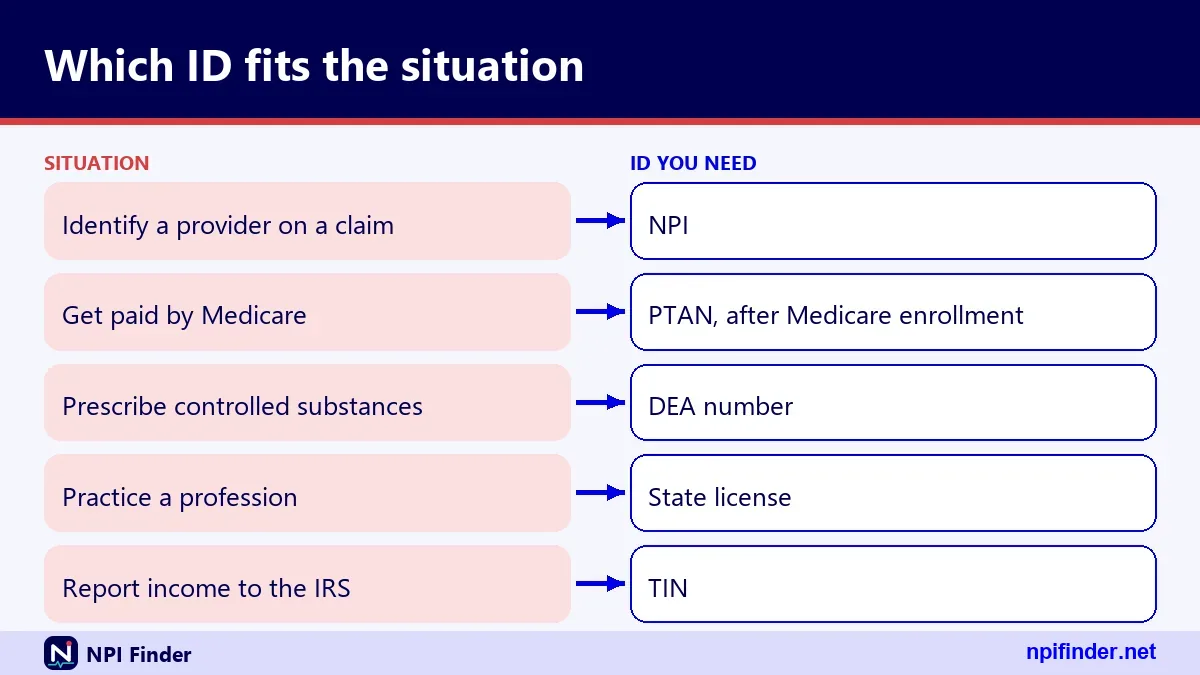
Choose the ID by asking who needs it. Billing a payer needs an NPI. Medicare enrollment needs a PTAN. A tax form needs a TIN. A pharmacy needs an NCPDP or NABP number. A prescriber proves controlled-substance registration with a DEA number.
If two answers seem possible, ask the requester for the exact name of the number. That one question prevents most rejected forms.
Provider ID synonyms decoded
Many provider id searches are really the same few identifiers under different names. This table maps the common phrases.
| What people type | What it usually means |
|---|---|
| Doctor provider id number | NPI |
| Dr provider id number | NPI |
| Physician provider id number | NPI |
| Medical provider number | NPI or PTAN, depending on context |
| Medicare provider number | PTAN |
| Medicare ptan number | PTAN |
| Medicare provider number lookup by NPI | PTAN, ask your MAC |
| RR MCR PTAN lookup | PTAN, so ask your MAC |
| Primary care provider number | Plan-specific PCP ID |
A sample Registry record walked through, field by field
A real Registry record makes the identifier mix concrete. The sample behind this site is an individual NPI-1 record for NPI 1003000126.

The basic block shows enumeration date 2007-08-31, last updated 2025-05-28, status "A" and sole_proprietor "NO". The addresses list holds a LOCATION and a MAILING address with the same street. The practiceLocations list adds three more sites. Four taxonomy rows each carry a license number and state, and one is flagged primary.
Notice what is missing. There is no PTAN, no DEA number and no tax ID. The identifiers, other_names and endpoints lists are empty. That is exactly why you need other sources for the other numbers.
Who must have an NPI and who may get one
Covered health care providers must get and use an NPI. A covered provider is one that sends health information electronically in a HIPAA standard transaction. That is the rule in 45 CFR 160.103 and 162.410.
Other providers may also get one. Non-covered prescribers need an NPI even though they are not required to apply, and organizations must require their non-covered prescribers to obtain one. Entities that do not provide health care, such as a transportation service, are not eligible. Medical students, interns and residents are not covered providers under HIPAA.
Three ways to get an NPI before you chase other IDs
You apply for an NPI first, because other enrollments ask for it. CMS recommends the web application as the most efficient route.
- Web application through NPPES, which CMS says is the fastest.
- Paper form CMS-10114 mailed to the NPI Enumerator.
- Electronic File Interchange, a bulk method through an authorized organization.
Read Apply for an NPI for the step-by-step version. We do not publish a processing time, because CMS does not state one.
What an NPI application asks for
The application collects identity and practice data. For an individual: name, Social Security Number or ITIN, date of birth, mailing and practice addresses with phone numbers, taxonomy codes and license details where applicable.
For an organization: the legal business name, EIN, an authorized official and a contact person. The paper form says SSN, ITIN and date of birth are not made available on the internet. Other submitted information may be.
Medicare enrollment forms and which provider they fit
Your NPI gets you into PECOS, but the form you file depends on who you are. The table lists the common CMS-855 forms.
| Form | Who files it |
|---|---|
| CMS-855A | Institutional providers |
| CMS-855B | Clinics, group practices and certain other suppliers |
| CMS-855I | Individual physicians and non-physician practitioners |
| CMS-855O | Physicians and eligible professionals who order or certify but do not bill Medicare |
| CMS-855S | DMEPOS suppliers |
Online enrollment through PECOS is paperless. Paper applications go to your MAC, and DMEPOS suppliers go to the National Provider Enrollment contractors.
Revalidation timing at a glance
Revalidation keeps your Medicare billing privileges active, and the PTAN is the number that depends on them. Providers and suppliers revalidate every five years. DMEPOS suppliers revalidate every three years. CMS may request an off-cycle revalidation.
CMS posts due dates seven months in advance and sends notices three to four months before the date. You may revalidate within three months of the due date even without a notice. There are no extensions and no exemptions.
Why legacy IDs faded and which ones survived
The NPI was meant to replace the many numbers each payer once assigned. CMS says legacy identifiers such as the UPIN, Medicaid numbers and Blue Cross Blue Shield numbers are not permitted in standard transactions once the NPI is used.
Some numbers survived because they do different work. The TIN still serves tax reporting. The PTAN still identifies your Medicare enrollment. The DEA number still tracks controlled substance registration. Licenses still come from boards. The NPI simply took over the job of naming you on a claim.
Using these IDs together in a credentialing packet
A credentialing packet often asks for several IDs at once. Bring the NPI, the license number and state, the DEA number if you prescribe controlled substances, the tax ID, and the PTAN if you are enrolled in Medicare.
Put the NPI on every form. Copy license numbers from the board, not from memory. Check that your NPPES address matches the address you give the plan, because mismatches slow reviews.
An NPI search returns zero results: what to check
A zero-result search usually means a typing or wildcard problem, not a missing provider. Work through three causes in order.
Wildcard and exact-match mistakes
Wildcards need at least two leading characters and work only at the end of a word. A last name without an asterisk must match exactly. Misspellings return nothing.
A failed check digit
A 10-digit number that fails the Luhn check returns an empty result, not a check-digit error. Run it through the NPI Number Validator before you assume the provider is missing.
Deactivated or recently changed records
A deactivated NPI shows only limited information in the downloadable files, and the Registry is updated daily. Check back after a day if the record is brand new.
Wrong or stale registry data
Registry data can be wrong because providers maintain it themselves. CMS requires covered providers to update NPPES within 30 days of a change, but the NPI does not validate licensure or credentials.
Outdated addresses
If a practice address is old, the provider should fix it. Point them to Update or Deactivate an NPI.
Mailing address is not the office
Mailing addresses are often an office box or another office. Use the location address to find where a provider sees patients.
The 30-day rule
Report changes within 30 days, online or on the paper CMS-10114 form. Medicare enrollment updates are separate.
Cannot log in to update NPPES or PECOS
Login trouble is almost always an I&A account issue, not an NPI issue. Your NPI, enrollment and payments are not affected.
Expired passwords and locked accounts
I&A passwords expire every 60 days. Three failed logins lock the account. Use Forgot Password to unlock it. See NPPES Login Help.
Multi-factor authentication
MFA has been required since April 21, 2022. Set up two methods if you can, so you are not stuck if one fails.
Contact the help desk
The External User Services Help Desk handles I&A, NPPES and PECOS account problems. Its number, 1-866-484-8049, is listed in the CMS I&A FAQ.
Sites that charge for IDs or lookups
CMS lists no fee to get an NPI, use the Registry or download the data files. A site that charges for any of them is not CMS.
NPI applications
Apply through NPPES. Our guide at Apply for an NPI walks through it. Paper applications use the CMS-10114 form.
PTANs and EINs
Your MAC assigns your PTAN and the IRS issues your EIN directly and free. No middleman is needed.
Look-alike invoices
CMS has warned about look-alike CLIA invoices. Treat any unexpected bill for an identifier with caution.
Medicare billing fails even though you have an NPI
An NPI alone does not let you bill Medicare. Enrollment through PECOS is a separate step, and a few common gaps explain most failures.
Not enrolled yet
Having an NPI does not enroll you in Medicare. Complete the right CMS-855 form, such as 855I for individual practitioners.
Revalidation overdue
Late revalidation can lead to a payment hold and deactivation. Reactivation needs a new complete application, and services during deactivation are not reimbursed.
Data mismatch between NPPES and PECOS
Updating NPPES does not update PECOS. Update both. For finding enrolled doctors, see Find a Medicare Provider.
45 CFR Part 162 rules that govern the NPI
The NPI rules sit in Subpart D of 45 CFR Part 162. Several sections matter day to day.
- 162.404: compliance dates.
- 162.406: the standard, ten positions, no embedded intelligence.
- 162.408: the National Provider System, subparts, no reassignment of deactivated NPIs.
- 162.410: duties of covered providers, including the 30-day update rule.
- 162.412: health plans may not require a second NPI.
- 162.414: clearinghouses.
What it costs: the free parts and the paid traps
Getting an NPI costs nothing, and neither does searching the Registry or downloading the data files. CMS lists no charge for any of them.
You may still pay for other things. Commercial use of the NUCC taxonomy code set requires a license, though use in claims and provider applications is free. Third-party sites sell convenience, not access.
Official sources and who to contact
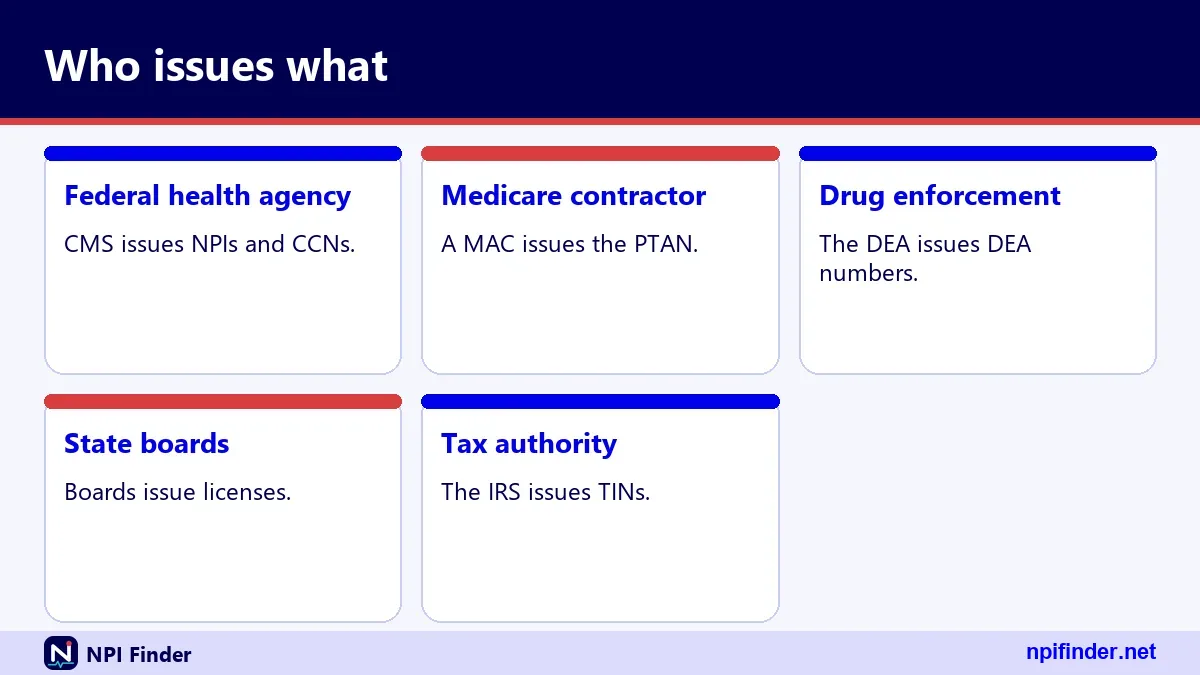
Go to the primary source for each ID. CMS runs NPPES, the NPI Registry and PECOS. The IRS issues EINs. The DEA issues DEA numbers. State boards issue licenses.
For NPPES questions, the NPI Enumerator is reachable at 1-800-465-3203. For account access, use the EUS Help Desk. For Medicare enrollment, contact your MAC. Learn how NPPES works in NPPES Explained.
What the Registry makes public
The Registry shows names, addresses, phone and fax numbers, taxonomies and license numbers. CMS says the data must be disclosed under FOIA. For individuals, the SSN, ITIN and date of birth are not made available on the internet.
Mailing addresses can be a provider's home. That is a reason to enter the practice address carefully when you apply or update.
Glossary of provider ID terms
Use this list to decode forms and search results.
- NPI: National Provider Identifier, ten digits, issued through NPPES.
- NPPES: the CMS system that assigns and stores NPIs.
- I&A: Identity and Access, the account system for NPPES and PECOS.
- PECOS: Medicare's enrollment system.
- PTAN: Medicare billing identifier issued by a MAC.
- MAC: Medicare Administrative Contractor.
- CCN: CMS Certification Number for Part A facilities.
- TIN and EIN: tax identifiers issued by the IRS.
- NUCC taxonomy: the ten-character code set for specialty.
- UPIN: the retired Medicare physician identifier.
Myths versus facts about provider IDs
Most confusion comes from a handful of myths. The table sets them straight.
| Myth | Fact |
|---|---|
| An NPI proves a doctor is licensed | The NPI does not verify license or credentials |
| NPI and PTAN are the same | They are separate; you need both for Medicare |
| NPIs expire | The NPI does not expire |
| Updating NPPES updates Medicare | PECOS must be updated separately |
| You can get a second NPI to bill a different plan | Plans cannot require a second NPI, and individuals get one |
| A passing check digit means the NPI is real | It only proves the format is valid |
| An NPI costs money | CMS lists no fee |
Advanced: taxonomy codes and the identifiers field
Two parts of the Registry record reward a closer look. They explain why two doctors with the same specialty can look different.
Reading taxonomy codes
NUCC taxonomy codes are ten characters long and organized by grouping, classification and specialization. Version 26.1 took effect July 1, 2026. For example, 207Q00000X is Family Medicine and 207RC0000X is Cardiovascular Disease under Internal Medicine.
The identifiers list
The identifiers list can hold up to 50 other IDs, each with a code, description, state and issuer. The sample record has none. Do not expect a PTAN or DEA number there.
Tips for working with provider IDs
These ten habits prevent most ID mistakes.
- Name the number. Ask which agency issues the ID before you submit anything.
- Verify the check digit first. A quick check catches typos before they reach a claim.
- Search narrow, then wide. Start with the full name and state, then loosen.
- Use the location address. The mailing address may not be the office.
- Keep a one-page ID sheet. List NPI, PTAN, tax ID, license numbers and DEA in one secure place.
- Update within 30 days. Changes to NPPES are your duty as a covered provider.
- Update NPPES and PECOS separately. One does not feed the other.
- Do not pay for lookups. Public Registry data is free.
- Use the file for bulk work. Hourly query limits apply to the Registry.
- Confirm licenses with the board. The NPI cannot do it.
Recommendation
Keep the NPI as your primary identifier and treat everything else as a labeled supporting number. Search the Registry for NPIs, ask your MAC for your PTAN, ask the state for licenses and Medicaid IDs, and use the IRS only for tax IDs. If you are the provider, keep one record of every number and update it whenever something changes.
For your next step, try NPI Lookup by Specialty, or grab the NPI file at NPI Database & Download.
Where to go next on NPI Finder
Start from the home page to search the Registry. Learn the basics in What Is an NPI Number?. Browse state-level results in NPI Lookup by State. Revalidating? See PECOS Lookup & Revalidation.